Fleet & trailers
Boats and hull classes, trailer geometry (rows, slots, posts, axles, bed), the printable measurement worksheet, tow vehicles and loose items.
Boats
Boats are read from Boathouse Connect — name, manufacturer, model, year and status stay in BC and are refreshed on sign-in and whenever you press Sync on the Boats page. RiggerPlus adds what BC does not know: the hull class (1x, 2x/2-, 4x/4+, 8+ and so on) and the dimensions that decide whether a boat fits a slot.
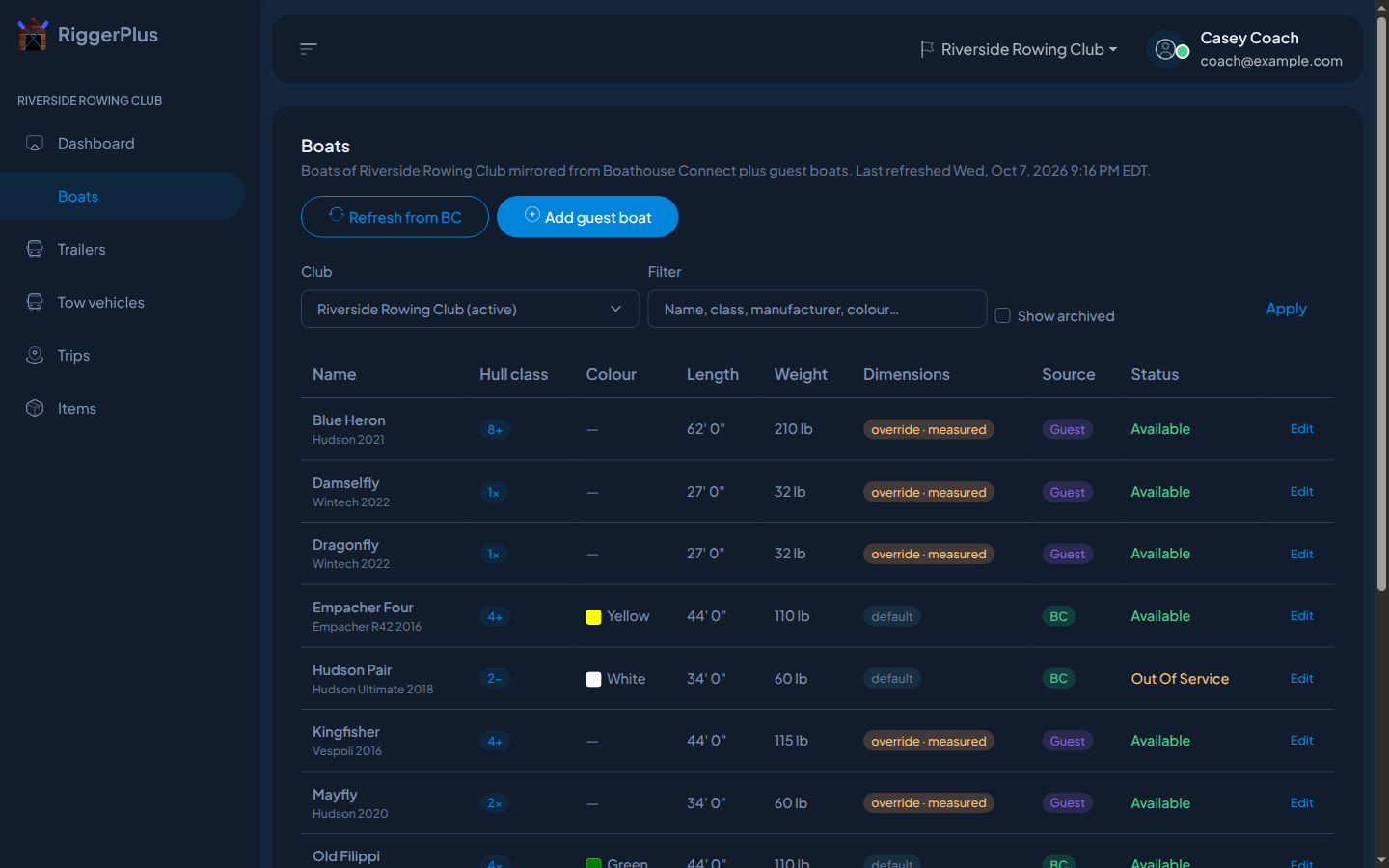
Dimensions come in three flavours
| Source | Meaning |
|---|---|
default |
Taken from the hull-class catalogue (manufacturer-specific where we have it, otherwise the class default). Nothing to do. |
manual |
You typed a value over the default — e.g. a shorter bow because of a non-standard bow ball. |
measured |
You measured the boat; all values are yours. |
The fields are overall length, bow → gunwale, gunwale length, gunwale → stern, beam, depth and weight. Fit checks use the gunwale section (the part that rests on racks) rather than the whole hull, which is why the bow/stern proportions matter. Reset dimensions to hull-class defaults throws away your overrides.
Guest boats
A boat you are towing for another club does not need to exist in your Boathouse Connect fleet: add a guest boat with a name, hull class and (optionally) an owner. It behaves like any other boat on the trailer and disappears from pickers once archived.
Trailers
A trailer is described in five steps; the side-view preview updates as you type and Geometry checks lists anything inconsistent (a post past the end of the bed, a slot wider than the row, an axle outside the frame).
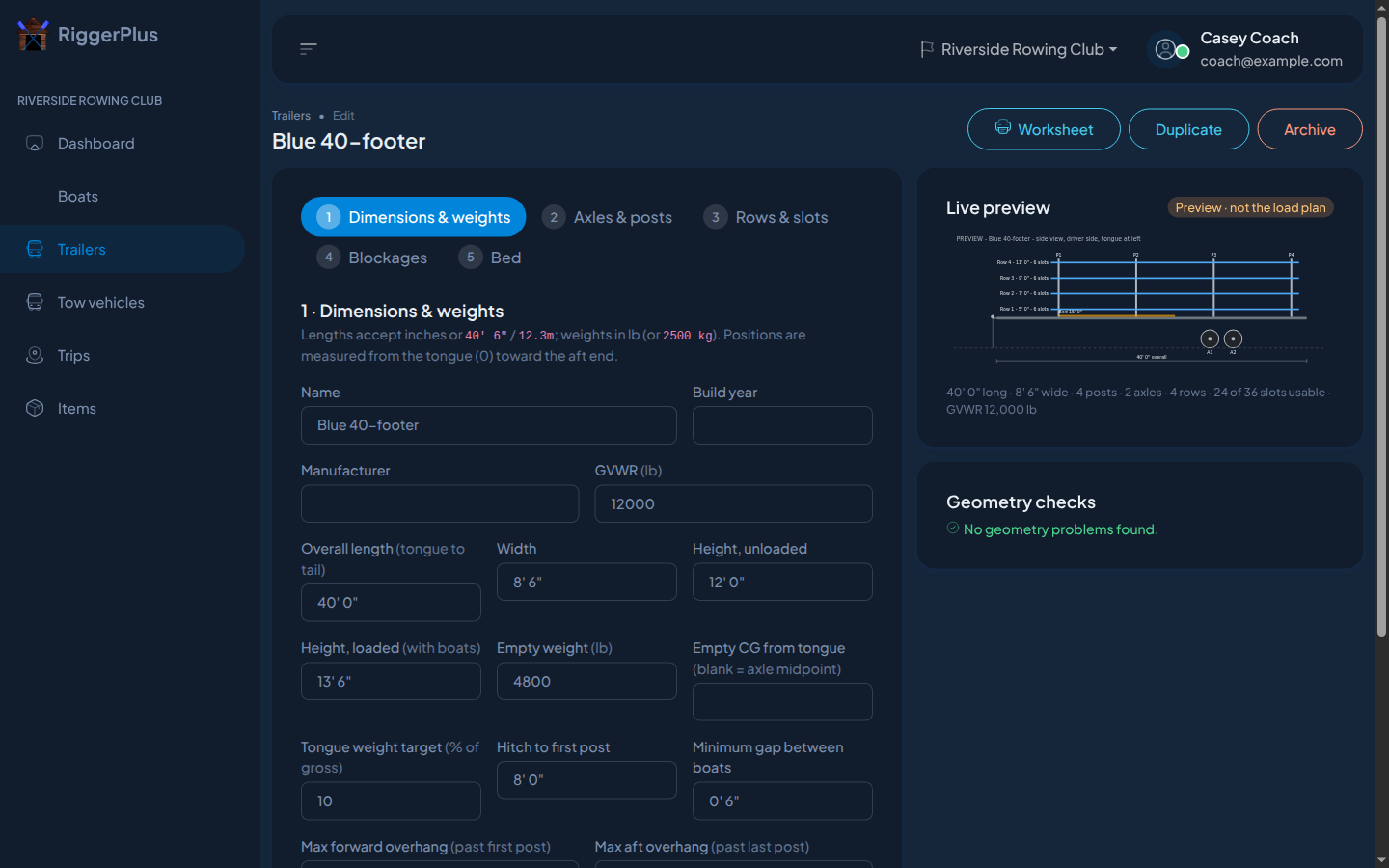
- Dimensions & weights — overall length, bed length, width, height of the top rack from the ground, tongue length, empty weight, GVWR and the maximum tongue weight. These drive the overhang and weight checks.
- Axles & posts — position of each axle (and its rating) and of each upright post measured from the tongue. Boats must rest on at least two posts; a rack span between two posts is what a slot sits on. A post that stops short of the top — a small-boat tree bolted between the main posts that only reaches rows 1–3 — gets Up to row 3: it counts as support (and draws) on rows 1–3 only, so those rows take more 1x/2x/2- end-to-end while the upper rows keep the long spans for eights.
- Rows & slots — each row is one rack height; each row has driver, center and passenger slots, each with a forward and aft position (two boats end-to-end) or a single long slot. Rows can be marked slung (boats hang below in slings instead of resting on racks).
- Blockages — parts of a row you cannot use (a spare-tyre mount, a light bar): slot ranges become
blocked_from_in … blocked_to_inand placements there are refused. - Bed — the flat deck where riggers, oar boxes and coolers go, used by the items checklist and bed warnings.
Trailers can be duplicated (your own) or copied from a template (the three global templates any club can start from). Archiving hides a trailer from pickers but keeps the trips that used it intact.
Measure your trailer
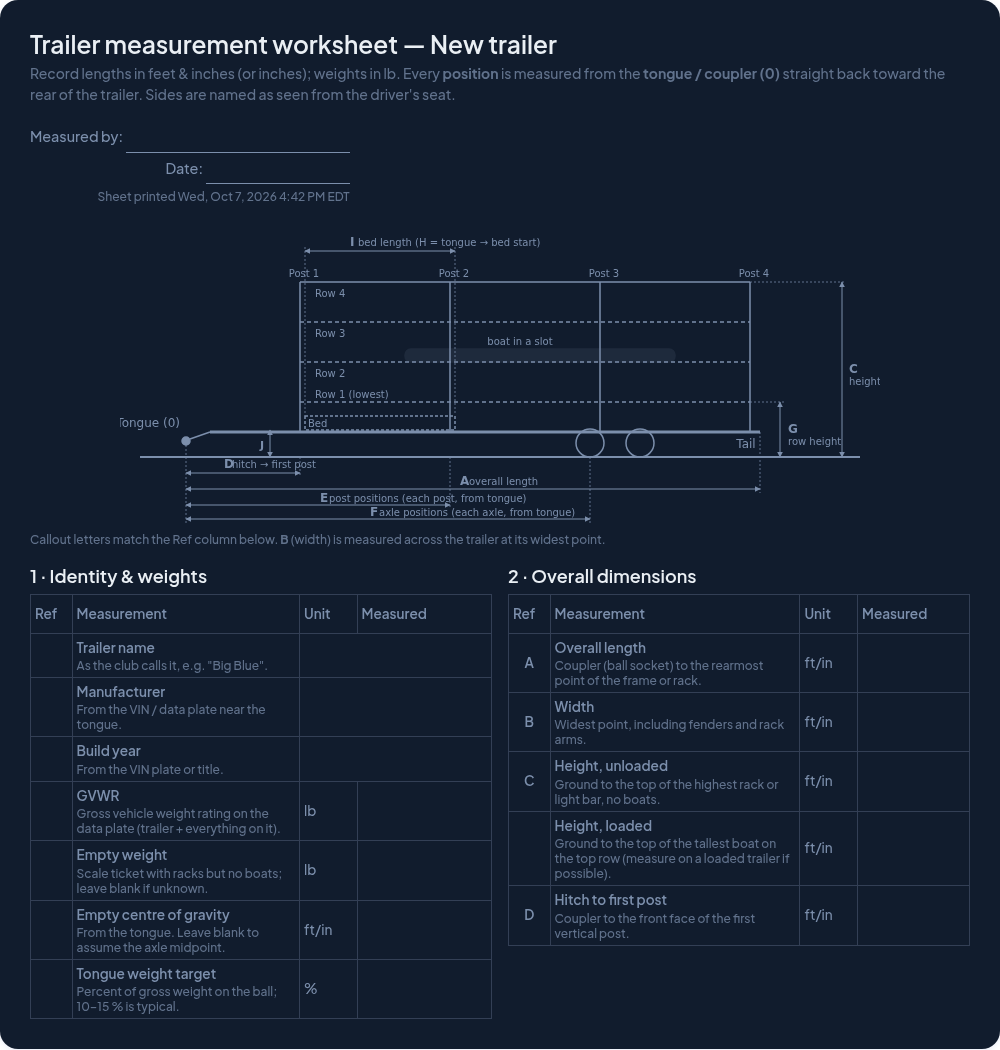
Print the measurement worksheet (/webapp/trailers/worksheet, or Worksheet on a trailer for a pre-filled copy) and take it to the lot. It walks through the dimensions in the order the editor asks for them, with a row table for driver, centre and passenger slots on up to five rack rows.
Tips that avoid re-measuring:
- Measure every post and axle from the front of the tongue (the ball coupler), not from the bed — that is the trailer's zero in every diagram.
- Record rack height from the ground for each row; it decides which rows can take deep hulls under the cab roof-line and which boats shadow the driver's view.
- Note the usable width of each slot rather than the rack width — rigger pads and tie-down rails eat into it.
Tow vehicles
A tow vehicle supplies the numbers routing and physics need: cab height (for the forward overhang over the roof), overall length and hitch geometry (rear bumper to ball), max tow, max tongue weight and GVWR.
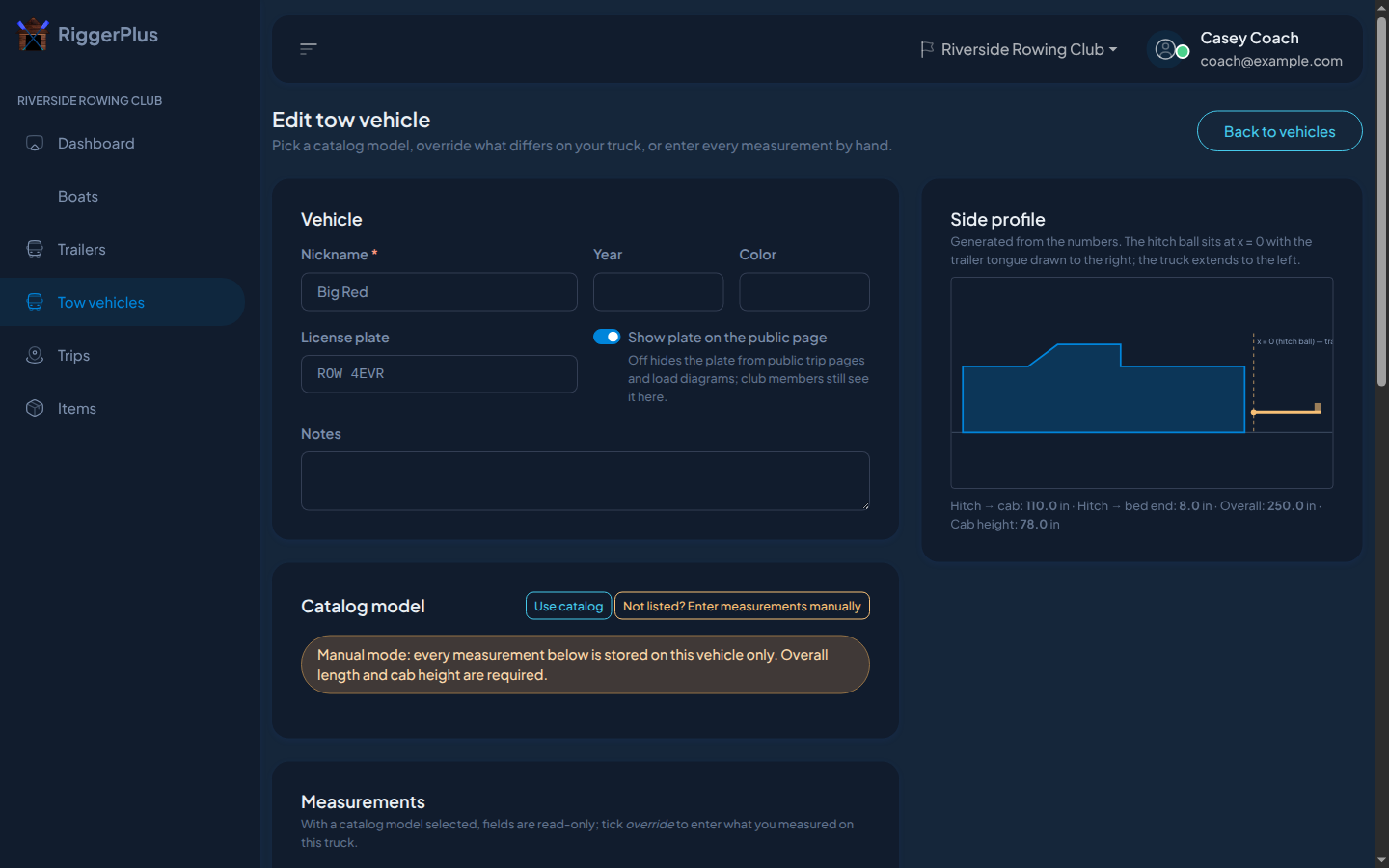
Pick a model from the catalogue (make / model / year, with a suggest button that scores partial matches) and only override what differs on your truck, or enter measurements by hand. If you measured a vehicle the catalogue lacks, Propose catalog model contributes it as a measured row so the next club finds it. Vehicles belong to a club, can be archived and restored, and carry a licence plate you may choose to show on the public trip page.
Items: oars, riggers, slings and the rest
Anything that is not a boat is an item: a catalogue entry with a category (oars, riggers, slings, erg, cooler, tools, spares, other), a default quantity, a unit weight and optional dimensions. Common items ship as a read-only global catalogue that you can copy into your club and edit.
On a trip, items are added to a trailer from a stop and optionally removed at a later stop, exactly like boats, so the weight they add shows up in the physics for the legs they ride. They can be given a bed position (inches from the tongue) so riggers and oar boxes appear on the side-view diagram and the bed warnings can flag an overloaded tail. See Trip day for the loaded / unloaded checklist drivers use.